What Is Backin? German Baking Powder and How to Use It


What is Backin?
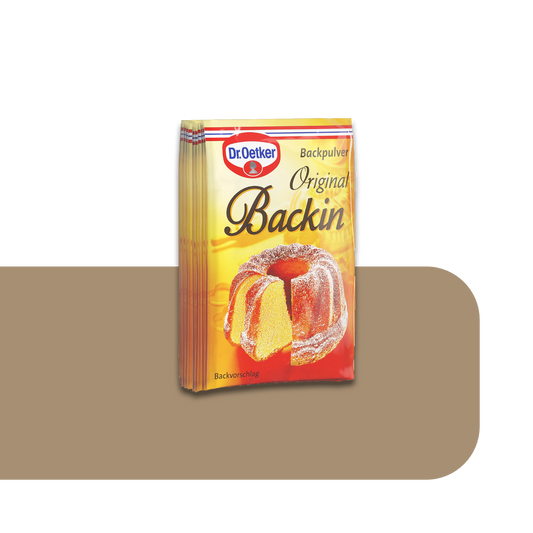
Backin is Dr. Oetker's baking powder, and it is the raising agent almost every German cake recipe means when it says Backpulver. The difference from a British tub is that it comes in single-bake sachets: one 16g sachet is the stated dose for 500g of flour.
That one detail is why German recipes say "one sachet" rather than "two teaspoons", and why a British baker reading a translated recipe often has no idea how much to use.
Why sachets instead of a tub
A tub of baking powder sits open in a cupboard and slowly loses strength, because the raising agent reacts with moisture in the air. A sealed sachet does not. Each one is opened, used and thrown away, so the last cake of the pack rises exactly like the first.
It also removes the measuring. German recipes are written around the sachet as a unit, so the instruction is simply to add one, and the proportion is correct by design.
Converting a German recipe
If a recipe calls for one sachet of Backin and you only have British baking powder, the rough equivalent is:
- One 16g sachet is roughly three level teaspoons of ordinary baking powder.
- That amount is intended for 500g of flour.
- For 250g of flour, use half a sachet, or about one and a half teaspoons.
Treat that as a working conversion rather than an exact one. Baking powders differ slightly in strength between brands, and the sachet is calibrated to this one.
What it does in the dough
Backin is a chemical raising agent. Mixed into a batter it releases carbon dioxide when it meets moisture and heat, and those bubbles are what lift a sponge. It works on its own, without needing an acid ingredient in the recipe, which is the practical difference between it and bicarbonate of soda.
That matters when you are substituting. Baking soda needs something sour in the mix to react with, such as buttermilk or lemon juice. Backin does not, so it suits plain sponges, marble cakes and anything where the recipe brings no acidity of its own.
Using it well
Sift it through the flour rather than tipping it into wet batter, so it distributes evenly. Uneven powder gives a cake that rises in patches.
Get the tin into the oven reasonably promptly once mixed. The reaction starts when the powder meets moisture, so a batter left standing on the counter has already spent some of its lift.
And resist adding extra for a taller cake. Too much raising agent produces a cake that climbs quickly, then collapses in the middle, with a faintly soapy aftertaste.
The mistake people make
The commonest error is opening a sachet, using a spoonful and saving the rest. Once the seal is broken the sachet is no better than an open tub, and worse, because it cannot be closed. If a recipe needs half a sachet, use half and accept losing the other half, or bake something else with it the same day.
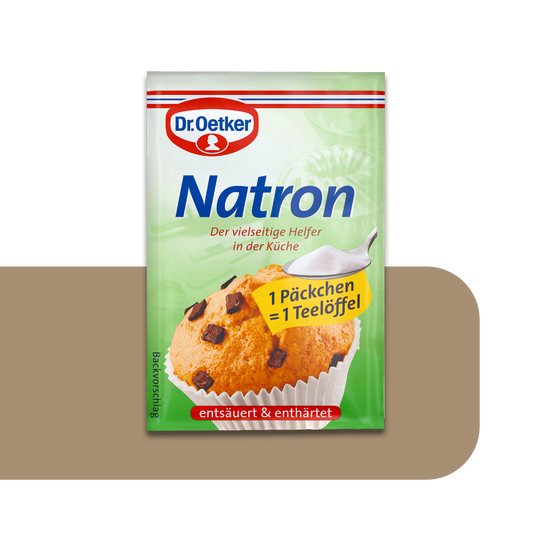
The second commonest is assuming Backin and Natron are interchangeable because both are white powders in small sachets from the same brand. They are not, and swapping them is the fastest way to a flat cake.
A little history
Original Backin was created by Dr August Oetker in 1893, and the sachet has been in German kitchens for more than a hundred years since. That longevity is why the brand name works as the generic term: in a German recipe, Backin and baking powder mean the same thing.
What we stock
Our Dr Oetker Original Backin in the pack of ten 16g sachets is the standard article, enough for ten cakes at 500g of flour each.
It sits with the rest of the raising agents in our German leavening agents section, alongside Natron, which is the bicarbonate of soda that Backin is regularly confused with.
The short answer
Backin is German baking powder in pre-measured sachets. One sachet, 16g, for 500g of flour, or about three teaspoons if you are converting. Sift it in, bake promptly, and do not add extra.
What we stock
-
Dr Oetker Original Backin Baking Powder | 10 x 16 g
Regular price £1.89 GBPRegular priceUnit price per -
Dr Oetker Natron Baking Soda | 5 x 5 g
Regular price £1.09 GBPRegular priceUnit price per